I am still overwhelmed at the busy-ness of August and my inability to fit in a "regular" practice routine. I've been doing lots of travel, and using the car/bus/airplane time to do mental practice, but brother my chops are in rough shape! Can't wait for this latest, and last, trip to be completed so I can resume feeling like a Real Musician.
Meanwhile, this email came to me recently and I wanted to share it with all of you: a series of professional development webinars that Polyphonic hosts throughout the year. They are FREE! and I've participated as a viewer several times in the past. My main interest has been in hearing how young graduates from music schools are carving their own paths in the new classical music scene (you know, post 9/11 economic bust, new anti-intelligence culture, etc.).
But the very first one they are offering is the one I would most like to direct your attention to. It's with Don Greene, my hero!, who coaches athletes, military and now musicians in achieving optimal performances. He's the one who set me on the path of mental practice. It's September 16 at 8pm Eastern time, and they usually last just under an hour. Once you register, they tell you all the technical details of how to log on and participate. (it's easy, trust me) There is usually a Q and A at the end that is moderated - you type your questions to the presenter and the moderator chooses which ones to pass along.
I highly recommend these free webinars. We're all in it for the long haul, the atmosphere for live performance is changing so rapidly, and there is sooooo much to know and learn. Take advantage of tools like these and keep yourself "in school" and open to new ideas.
Happy practicing!
Gaelen
Tuesday, August 20, 2013

Sunday, June 16, 2013
It's show time!
About to head over to the Eastman School in a bit to set up for my class's end of year recital. I suppose that's nothing really new to most of us who took lessons in our youth. For me, the bigger deal is that I just got back yesterday from a week of being a student again, at the Early Music on Modern Instruments workshop. A whole week, 12 hours a day, of learning a "new language" and trying to subvert my standard modern approach/training that is really deeply grooved into my brain. I'll write more about the experience and what in particular I took away from the EMMI workshop, but for now I want to just honor how awesome and scary it is to be a student and have to play in front of everyone. It's been quite a while since I had to perform with the weirdness of not feeling fully ready. Of wanting to show off everything I had only just learned, meaning things that are NOT part of my muscle memory yet. And of course, wanting to look good doing it all, in front of teachers and other students. Just set the bar kinda high, why don't I?
So, for now I want to say, it is OK to be a beginner. To go into these things knowing that you'll do your best and some things will happen and some won't. It's all part of the journey of being an artist. Being a human. And certainly we can prepare well, we can do many things to get ourselves ready and relaxed, but accepting the flow of performance and sticking with it (not spacing out or just giving up while you're playing) is really key here.
Here's what I'm planning to say at the start of our recital today. I hope it's received in the spirit intended:
Today isn't about playing perfectly. It really isn't even about showing off all that you've learned, and you all have learned quite a lot this year. I've been honored to be with you as you discovered new ideas, as you tried out new techniques or phrases and were brave enough to just try them and see whether they flew or flopped. But today is really just about loving our instrument and enjoying the sounds we can make on them. You have prepared well, and now it's time to PLAY! Remember why you picked this instrument in the first place. And all these people sitting here? They love you and know you play well. We're just here to celebrate that together. Ready? Go!
Gaelen
So, for now I want to say, it is OK to be a beginner. To go into these things knowing that you'll do your best and some things will happen and some won't. It's all part of the journey of being an artist. Being a human. And certainly we can prepare well, we can do many things to get ourselves ready and relaxed, but accepting the flow of performance and sticking with it (not spacing out or just giving up while you're playing) is really key here.
Here's what I'm planning to say at the start of our recital today. I hope it's received in the spirit intended:
Today isn't about playing perfectly. It really isn't even about showing off all that you've learned, and you all have learned quite a lot this year. I've been honored to be with you as you discovered new ideas, as you tried out new techniques or phrases and were brave enough to just try them and see whether they flew or flopped. But today is really just about loving our instrument and enjoying the sounds we can make on them. You have prepared well, and now it's time to PLAY! Remember why you picked this instrument in the first place. And all these people sitting here? They love you and know you play well. We're just here to celebrate that together. Ready? Go!
Gaelen
Monday, April 29, 2013
Start now
I'm going to shamelessly repost a blog I just read, which itself was a snippet of another blog...
Because it is so incredibly to the point about just getting started and the (often stupid) things we let stand in our way (hint: it's us, we stand in our own way).
This is the post I suggest you read
There's a few f-bombs in there, so beware. But it comes straight from her heart and can all be applied to your practice and your direction as an artist. Set goals, be willing to change them. Don't whine about your situation, do something. Inform yourself. (man, that one alone is worth the price of admission)
One thing especially hits me: #10 complaining changes nothing, action changes everything. There have been too many times I've felt I was discriminated against, bypassed or completely overlooked in the orchestra world. And I spent my fair amount time of having a pity party. But waking up from that and grabbing the reins of my own career and my own playing was the best thing I ever did. For me that meant going back to get a Master's degree 10 years after getting my undergrad. Renting two apartments so I could continue to work in Rochester while I studied full time in Pittsburgh. Having very little social life for those two years while I racked up miles, practiced about 5 hours a day, gigged on the side, wrote papers for the degree, and took auditions for orchestra openings. Best Thing Ever.
Read it, I won't comment on it further. But I'd love to hear how you feel about your practice and goals once you read it.
Gaelen
Because it is so incredibly to the point about just getting started and the (often stupid) things we let stand in our way (hint: it's us, we stand in our own way).
This is the post I suggest you read
There's a few f-bombs in there, so beware. But it comes straight from her heart and can all be applied to your practice and your direction as an artist. Set goals, be willing to change them. Don't whine about your situation, do something. Inform yourself. (man, that one alone is worth the price of admission)
One thing especially hits me: #10 complaining changes nothing, action changes everything. There have been too many times I've felt I was discriminated against, bypassed or completely overlooked in the orchestra world. And I spent my fair amount time of having a pity party. But waking up from that and grabbing the reins of my own career and my own playing was the best thing I ever did. For me that meant going back to get a Master's degree 10 years after getting my undergrad. Renting two apartments so I could continue to work in Rochester while I studied full time in Pittsburgh. Having very little social life for those two years while I racked up miles, practiced about 5 hours a day, gigged on the side, wrote papers for the degree, and took auditions for orchestra openings. Best Thing Ever.
Read it, I won't comment on it further. But I'd love to hear how you feel about your practice and goals once you read it.
Gaelen
Monday, April 1, 2013
Slo-Mo
This just tickles the nerd in me... so much! I saw this video of a violin string being bowed shot at super slow speed so you can really see the oscillation of the string. It's crazy! Check it out for yourself, only a few minutes long, but you'll get the idea pretty quickly:
I'm not sure what to do with this new found knowledge. I'd love to say: apply it this way! But sorry, it's going to take me a minute more to figure this out. Meanwhile, enjoy the macro world of slow speed photography.
Happy practicing!
Gaelen
Happy practicing!
Gaelen
Friday, March 22, 2013
Mastering the Bow is now available!

I'm pleased to announce that years of work on the Wohlfahrt
violin studies have been published by Carl Fischer and are now available for
purchase. These are 38 études geared
towards beginning and intermediate students and teach the "mother
strokes" of détaché and martelé,
and the many combinations - in slurs, crossing strings, different meters,
varying degrees of shifting difficulty. The
book works progressively through détaché first, addressing the issues of
connected sound, then focuses on martelé and the technical ideas involved in
producing that stroke. My hope is make
video demos to support your practice of the études.
My graduate studies teacher, Jeffrey Turner, was working out
of a smaller version of these études, but we both felt that particular version
didn't offer enough practical help, or explain definitions of terms that can
often have conflicting uses. At Jeff's
encouragement, I researched some other books' definitions - like the Harvard Dictionary
of Music and Musicians and the Grove New Dictionary - to see how they
varied. I included those other
definitions in an appendix in this book, but started off the book with a
glossary of our terms and the way we use them to avoid confusion.
I hope you'll find clear and challenging work to help
improve your bow strokes in this book.
If you have any questions or suggestions for further material - hint,
hint, I'm starting work on book 2 now, the one that will take us into spiccato
and ricochet and would love to know what you like to work with or what you have
trouble with in your practice - I'm all ears!
Happy practicing!
Gaelen
Saturday, February 23, 2013
The intention in practice
I just got home from a lovely 6 days away visiting family, without a bass. So I had to start right away getting my chops back together for the upcoming concerts next week. What a pain! I am already so out of shape, it's just depressing. (know how this feels? I bet most of you do. It only takes a couple days to start losing the very fine coordination. It also only takes a little while to regain them.)
While I was away, I took a couple of yoga classes with my step-mother, and her yoga teacher had something she did at the start of every class that maybe every yoga teacher does... but this time I really heard it. She would talk about listening to where you are, and thinking about one thing to dedicate your practice to. Giving the practice intention. My back was sore from sleeping on so many different futons this week, that that was my simple intention - to allow my back to stretch and lengthen and (hopefully) feel more flexible. Simple, not too metaphysical.
Also, while I was away, I was reading a book called "Serving with Grace" about bringing spirituality into leadership/committee work at your church. And this too calls to us to bring intention to our actions. To place the needs of the group, the direction of the church, the process above the need to get stuff done.
So, what does this have to do with our practice? I was thinking about this today when I picked up the bass for the first time in six days, that I needed to honor just sticking to basics today. That the process of recovering my ability was enough. I don't need to berate myself for having iffy tone today, just to listen and think about what I'm doing. Check in with my body about posture, breath, open joints, and to be present in the process of practicing.
It's tough, I won't lie. I very quickly devolve into "ugh that shift is still flat" and have to remind myself to get back to the simple aspects of practice. One layer at a time (I think I already posted about that - making multiple passes through a passage, each time with a different focus, or intention, to keep yourself from getting overwhelmed with too many issues to fix). I already feel that practice has an inherently spiritual quality to it, almost meditative. But to take a moment and give intention to the work helps to keep perspective on what you are doing.
Happy practicing!
Gaelen
While I was away, I took a couple of yoga classes with my step-mother, and her yoga teacher had something she did at the start of every class that maybe every yoga teacher does... but this time I really heard it. She would talk about listening to where you are, and thinking about one thing to dedicate your practice to. Giving the practice intention. My back was sore from sleeping on so many different futons this week, that that was my simple intention - to allow my back to stretch and lengthen and (hopefully) feel more flexible. Simple, not too metaphysical.
Also, while I was away, I was reading a book called "Serving with Grace" about bringing spirituality into leadership/committee work at your church. And this too calls to us to bring intention to our actions. To place the needs of the group, the direction of the church, the process above the need to get stuff done.
So, what does this have to do with our practice? I was thinking about this today when I picked up the bass for the first time in six days, that I needed to honor just sticking to basics today. That the process of recovering my ability was enough. I don't need to berate myself for having iffy tone today, just to listen and think about what I'm doing. Check in with my body about posture, breath, open joints, and to be present in the process of practicing.
It's tough, I won't lie. I very quickly devolve into "ugh that shift is still flat" and have to remind myself to get back to the simple aspects of practice. One layer at a time (I think I already posted about that - making multiple passes through a passage, each time with a different focus, or intention, to keep yourself from getting overwhelmed with too many issues to fix). I already feel that practice has an inherently spiritual quality to it, almost meditative. But to take a moment and give intention to the work helps to keep perspective on what you are doing.
Happy practicing!
Gaelen
Wednesday, February 13, 2013
The tyranny of the bar lines
I woke up this morning thinking about bar lines, and the quote (that I think I can attribute to Anner Bylsma) about the "tyranny of the bar lines." I know, geeky place to start, but it's where my head is this morning. In his incredible book, Bach, The Fencing Master, Bylsma takes us into his eccentric mind and how he's thought about the six cello suites over the course of a lifetime of study and performance. There's nothing dull in there - poems, angry letters to Bach, analysis, line drawings.... He clearly had a lot of fun putting it all down on paper.
Ok, so there are bar lines in there. But not every four beats. In fact, you had to learn this music from the chant leader, and follow their phrasing, breathing together, to create the shape of the music. How long do you hold a note? Follow the leader.
Modern notation allows the composer almost complete control over the way the phrase will be performed. At times, this feels like a tyranny to me, personally. When I look back at Bach and Mozart, there is rhythmic notation and some dynamic indication, but the musician needs to understand style and have good musical instincts to execute beautiful phrases. Which means you and I won't necessarily play the same phrase the same way. Or even that I will play it the same way every time I work on that piece of music. I like that! I like bringing my experience and emotion to a work fresh every time I perform it. Modern composers can dictate the tiniest details to us, and can at times overwhelm the musician with TMI.
But I'm still not on topic yet - the tyranny of the bar lines. As you look at your music, look for the greater shape of the phrase. It may be Classical in nature, which means 4 or 8 bar phrases, usually two phrases that combine to create one longer line - conversational. But don't let the bar lines fool you into thinking every beat ONE has to be strong, needs to be brought forward. How does the rhythm flow? Is it straight forward, or are there syncopations that want to be flourished? Benjamin Zander gave a delightful Ted Talk about this, and early in the talk he said he viewed music (I'm paraphrasing here) as a crow flying over a field and the fences below zipping by. To me, that's the image of the bar lines - not herding the rhythms together like so many sheep, but fences below as the melody soars over them. They may mark our place on the page, but the bar lines themselves are NOT the music.
Last thought on this: Bach 2nd Orchestral Suite in b minor, the Badinerie movement. It's written in 2/4, but as you listen, can you tell where beat one is? This will depend largely on the performer. I've played this with flutists who outright insisted on flipping the beat so beat 2 was the accented beat. I think that movement is a testament to looking at the shape of the phrase and playing it most naturally. Sometimes beat 2 will feel strong, sometimes beat 1. Go with the flow.
Happy practicing!
Gaelen
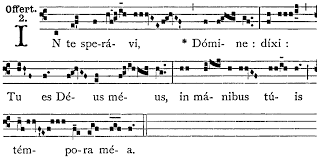
At one point he talks about the tyranny of bar lines, which in my lingo means the way the notes are all corralled in by those lines. He encourages us to think longer in phrasing, and to remember that bar lines are just a way of organizing the music. Early music (no, not Baroque music, go way earlier) didn't have bar lines and looked like this:
Ok, so there are bar lines in there. But not every four beats. In fact, you had to learn this music from the chant leader, and follow their phrasing, breathing together, to create the shape of the music. How long do you hold a note? Follow the leader.
Modern notation allows the composer almost complete control over the way the phrase will be performed. At times, this feels like a tyranny to me, personally. When I look back at Bach and Mozart, there is rhythmic notation and some dynamic indication, but the musician needs to understand style and have good musical instincts to execute beautiful phrases. Which means you and I won't necessarily play the same phrase the same way. Or even that I will play it the same way every time I work on that piece of music. I like that! I like bringing my experience and emotion to a work fresh every time I perform it. Modern composers can dictate the tiniest details to us, and can at times overwhelm the musician with TMI.
 |
| Henze isn't the greatest example of an overly controlling composer, but you start to get the idea |
Last thought on this: Bach 2nd Orchestral Suite in b minor, the Badinerie movement. It's written in 2/4, but as you listen, can you tell where beat one is? This will depend largely on the performer. I've played this with flutists who outright insisted on flipping the beat so beat 2 was the accented beat. I think that movement is a testament to looking at the shape of the phrase and playing it most naturally. Sometimes beat 2 will feel strong, sometimes beat 1. Go with the flow.
Happy practicing!
Gaelen
Subscribe to:
Posts (Atom)